






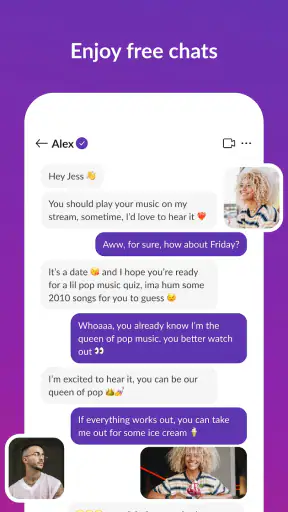

I approached MeetMe: Go Live & Stream Now as a social app rather than just another place to scroll. Its main appeal is the chance to watch live shows, follow conversations as they happen, and take part in a more immediate community than a normal feed provides. That immediacy is exciting at first, especially when I have a few spare minutes and want something more interactive than recorded clips.
MeetMe is developed by MeetMe.com and sits in the social category. It is free to install, although optional in-app purchases range from $0.99 to $249.99 per item. The app is rated Mature 17+, which is an important part of the decision: I would not treat it as a general-purpose family social network, and I would encourage anyone using it to think carefully about privacy, boundaries, and the kind of live content they want to encounter.
What the first week feels like
The first few sessions are easy to understand. I can open the app, browse live broadcasts, and move between hosts without needing to commit to a long video. The live format gives each room a different mood. Some streams feel casual and conversational, while others are more performance-oriented. That variety is what makes the app feel active instead of static.
The strongest early use case is filling short gaps in the day. If I am waiting for an appointment or winding down after work, a live broadcast can be more engaging than endlessly refreshing a conventional social feed. The possibility that a host may respond to a comment also changes the experience. I am not only consuming a finished post; I am watching a moment develop in real time.
MeetMe also makes sense for people who enjoy discovering personalities rather than following polished media brands. Live streaming has an unedited quality that can feel more personal than short-form video. At the same time, that openness means the quality is uneven. A room can be entertaining one minute and slow the next, so the app rewards active browsing rather than passive loyalty during the first week.
One practical habit helped me get more from it: I treated the first sessions as sampling rather than as a search for one perfect streamer. I watched briefly, noticed which conversations held my attention, and left when the room no longer felt worthwhile. That sounds obvious, but it prevents the common mistake of staying in a quiet stream simply because it was the first one opened.
The app has a substantial audience, with over 100 million installs and an average rating of 4.0 from around 1.6 million ratings. Those figures suggest that finding activity is one of its strengths, but popularity does not guarantee that every room will suit a particular user. The social experience still depends on the hosts available when I open the app and on how comfortable I feel joining the conversation.
Where the live format works best
I found the format most useful when I wanted lightweight company rather than a formal conversation. It can provide background interaction while I take a break, and it is more responsive than a feed of posts that were created hours or days earlier. For someone who enjoys chat-driven entertainment, this is a clear advantage over many ordinary social apps.
It is less suitable when I need reliable information, focused learning, or a carefully edited presentation. A live room is built around presence and personality, not necessarily depth or accuracy. If my goal is to learn a skill, watch a complete story, or avoid interruptions, a video platform with organized recordings is usually a better choice.
The age rating deserves attention during this early stage. Because MeetMe is marked Mature 17+, I would not install it for a teenager simply because the app looks like an ordinary social feed. Adults should also remember that live interaction can move quickly. I found it sensible to avoid sharing personal details in public conversations and to leave rooms that made me uncomfortable instead of trying to argue with the atmosphere.
Whether it earns a place after the novelty
Month-to-month value depends on routine
After the initial curiosity fades, the central question is whether live content becomes part of my routine. For me, the answer depends less on the number of available broadcasts and more on whether I return with a clear reason. The app has recurring value when I use it as a short social break, check in with familiar creators, or explore new rooms when I want spontaneous entertainment.
That value is different from what I get from a traditional social network. A normal feed is convenient because it remembers my interests through a stream of posts I can scan quickly. MeetMe is more event-like: the appeal comes from what is happening now. That makes it feel more alive, but also less dependable. If the people or conversations I enjoy are not active when I open the app, the experience can feel thin.
I would describe the app as a companion habit rather than a primary communication tool. It can add a social moment to a commute or evening, but I would not rely on it for important messages, organized group planning, or maintaining close friendships. A messaging app is better for direct contact, while a community platform with structured groups is usually better for long-running interests and searchable discussions.
The app’s recurring value also depends on how carefully I manage my attention. Live services are naturally designed around continued browsing, and the next room is always tempting. I got better results by deciding what I wanted before opening it: a quick look at live entertainment, a particular kind of conversation, or a few minutes of relaxed interaction. Without that limit, a short break can turn into an unfocused session with little memorable payoff.
Useful ways to keep the experience fresh
A less obvious strength is that the app can support two different habits. I can use it as a discovery tool, moving through unfamiliar broadcasts, or as a familiarity tool by returning to hosts whose style I already understand. The first mode preserves surprise; the second creates continuity. Switching deliberately between them helps prevent the service from becoming either repetitive or chaotic.
I also found it useful to separate watching from participating. Some days I only want to observe, while on others I am willing to comment and become part of the room. Treating those as different modes makes the app easier to fit around my mood. It also reduces the pressure to be constantly visible or socially available.
Another practical trade-off involves spending. The app is free, but optional purchases can become part of the social experience, especially if a user feels encouraged to support streamers or stand out in a busy room. I would decide on a personal limit before buying anything rather than making that decision during an exciting broadcast. The highest listed item price is $249.99, so this is not a detail I would ignore.
In my view, purchases should never be confused with better social value. Paying may change how I participate, but it does not guarantee that a stream will become more entertaining, that a host will respond, or that the app will become more useful month after month. The free experience is the right place to judge whether MeetMe belongs in my routine.
The maintenance burden is mostly social and attentional
MeetMe does not demand the same kind of upkeep as an app that requires a detailed profile, regular uploads, or a carefully organized library. The burden is subtler. I have to decide which rooms deserve time, manage the temptation to keep browsing, and remain alert to conversations that may not match my expectations.
That maintenance is manageable for someone who enjoys live communities, but it can feel tiring for anyone who prefers predictable content. A recorded video waits for me and can be paused. A live room moves on without me, which creates a mild pressure to stay. If I leave, I may miss a moment; if I stay, I may spend time waiting for one to happen.
Privacy is another ongoing responsibility. I would avoid revealing my location, workplace, contact details, or other information that could identify me. I would also be cautious about moving a conversation away from the app simply because somebody seems friendly. Live social interaction can feel intimate faster than it actually is, and the Mature 17+ rating is a reminder to use adult judgment rather than treating every room as harmless casual chat.
For streamers, the maintenance burden is likely greater because live content depends on showing up and holding attention. For viewers, it is mainly about curating the experience. I recommend leaving rooms quickly when the discussion becomes uncomfortable, repetitive, or overly focused on spending. There is no benefit in treating every broadcast as an obligation.
What causes fatigue over time
The biggest source of fatigue is inconsistency. The app can be lively, but not every room offers a strong reason to stay. Because live entertainment depends on timing, personality, and audience behavior, the quality can change from one visit to the next. That unpredictability is part of the charm during the first week, yet it becomes a weakness when I want dependable value.
Repetition is another concern. If I follow only a small circle of hosts, the same conversational patterns can begin to feel familiar in an unhelpful way. If I keep exploring without forming any connection, the app can become a sequence of brief visits with no lasting payoff. The best balance is to keep some familiar rooms while occasionally trying something outside the usual routine.
Social pressure can also wear me down. Live rooms often make participation visible, and the presence of reactions, comments, or spending cues may make quiet viewing feel less satisfying. I prefer using the app on my own terms: watching when I want, commenting when I have something useful to add, and ignoring the idea that I need to prove my interest.
Compared with short-form video apps, MeetMe offers more immediacy and a stronger possibility of direct interaction, but usually less polish and less control over pacing. Compared with messaging apps, it offers broader discovery but weaker private communication. Compared with large community forums, it feels faster and more personal, but it is not as good for building an organized knowledge base. The right alternative depends on whether I value live presence, private contact, edited entertainment, or structured discussion.
Who should use it, and who should skip it
I would recommend MeetMe to adults who enjoy spontaneous live broadcasts, casual social discovery, and the possibility of interacting with streamers or other viewers. It is particularly suitable for someone who likes to sample different personalities and does not need every session to have a clear beginning, middle, and end.
I would be more hesitant to recommend it to people who dislike unpredictable conversations, want strong control over what appears next, or are trying to reduce screen time. It is also a poor fit for anyone seeking a private replacement for texting. The app’s public, live nature asks for more caution than a direct conversation with people I already know.
The current version is 232.1 and it supports devices running Android 8.0 or later. That makes the basic compatibility question straightforward for many Android users, but the more important decision is behavioral: will live browsing add something meaningful, or will it simply create another feed to check? A newer version does not change that fundamental trade-off.
My long-term verdict
MeetMe earns lasting space for me only when I use it intentionally. Its first-week appeal is genuine: live broadcasts are immediate, varied, and more socially engaging than a silent stream of finished posts. The large user base gives the service a sense of activity, and the free entry point makes it easy to test without committing financially.
Its long-term weakness is that novelty alone cannot carry the experience. The app needs a personal routine, a few worthwhile rooms, and sensible limits around time and purchases. Without those, browsing becomes repetitive and the live format starts to feel like work rather than entertainment.
I would keep it installed for occasional live social breaks, not as my only social app. The best version of the experience is selective: open it with a purpose, explore confidently, protect personal information, and leave when the room no longer earns attention. Its lasting value comes from the people and moments I choose, not from staying online for as long as possible.
Overall, I see MeetMe as a worthwhile free social app for adults who genuinely enjoy live interaction, with a 4.0 average across a very large rating base and more than 253 thousand written reviews. The Mature 17+ label, optional spending, uneven room quality, and attention demands are real considerations. If those trade-offs fit my habits, it can remain a pleasant source of spontaneous company. If I prefer polished videos, dependable private messaging, or tightly organized communities, another type of app will serve me better.


